


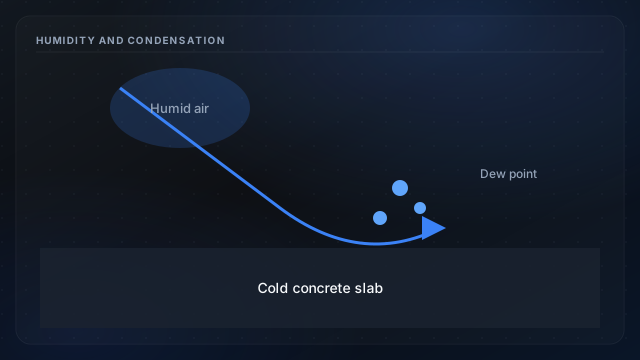
Garage monitoring pairs temperature with relative humidity because both drive comfort, corrosion, and mold risk. Condensation appears when humid air contacts a surface colder than the dew point, not when a humidity percentage alone crosses an arbitrary line. Probes measure the air pocket around the sensor; they do not directly detect water on a concrete floor unless that surface heats or cools the nearby air measurably.
Relative humidity versus dew point
A DHT22 reports **relative humidity (%RH)** at the current air temperature. The same moisture content feels “wetter” when air is cold because %RH rises as temperature drops. For freeze-season storage, track both temp and humidity together: DHT22 overview explains accuracy limits.
After door openings on humid summer days, expect a humidity spike as outdoor air mixes in. If the slab stays cold from thermal mass, condensation can form even when the probe reads moderate %RH at chest height.
What probes miss
- Surface temperature of tools, cars, and pipes, often colder than air at night.
- Microclimates behind shelving where air stagnates: use multi-zone layout.
- Short spikes during door events that averages smooth away in history.
Practical monitoring habits
Compare door-adjacent and interior zones via probe labels. Review overnight minimums in history charts during shoulder seasons when slab and air temps diverge most.